
A website can appear in search results and still attract the wrong enquiries. It can be mentioned in an AI answer that describes its services incorrectly. It can publish a useful explanation, earn a qualified visit, and lose that visitor to a broken mobile form. These are different problems, and they need different fixes.
SEO, AEO, GEO and SXO provide useful labels for examining that journey. They become less useful when businesses treat them as four unrelated products, each requiring a new budget and its own collection of tricks. The practical question is simpler: where does a potential customer stop progressing, and what evidence would help us remove that obstacle?
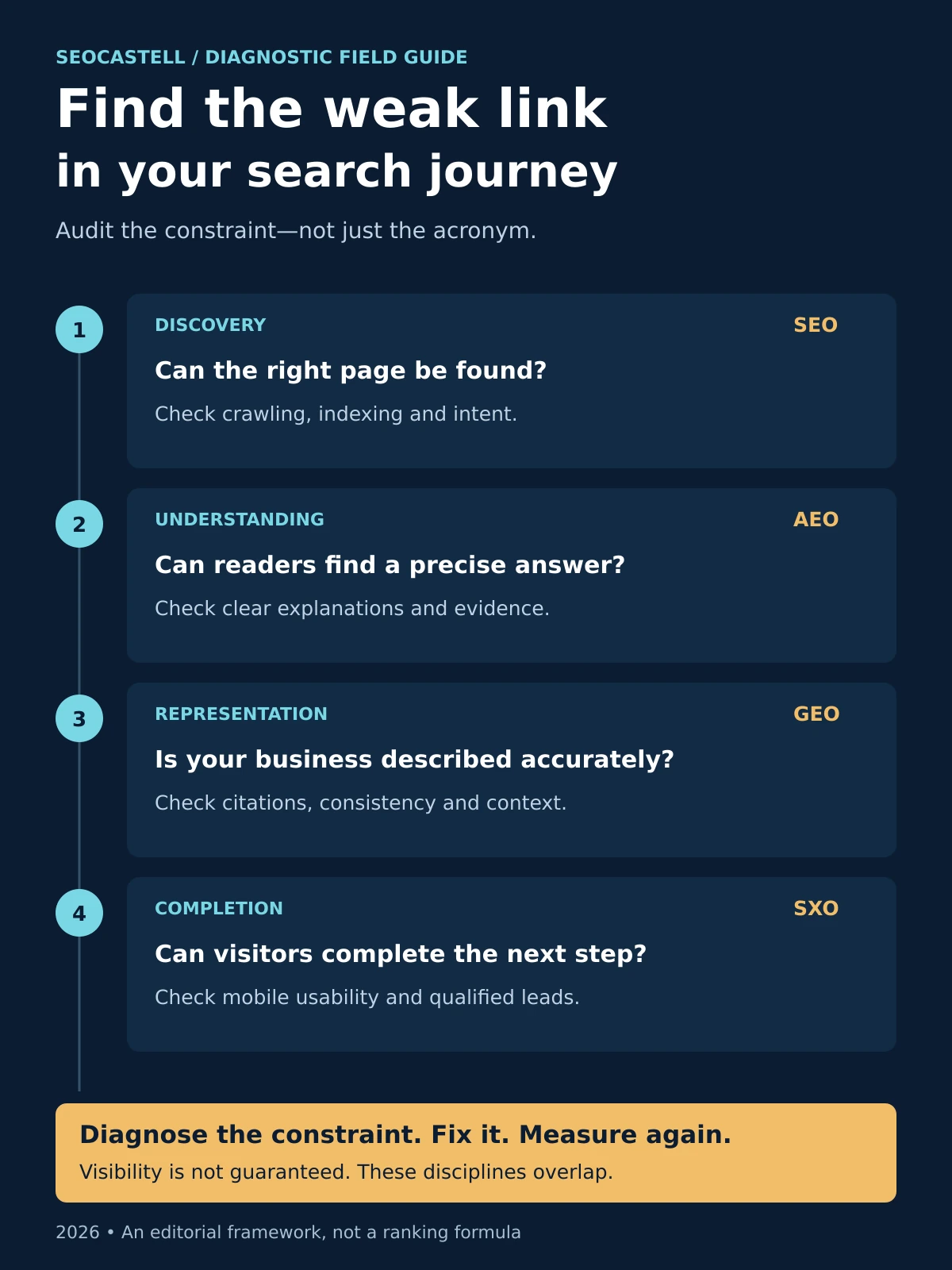
This guide introduces a page-level diagnostic method for marketing managers, editors and developers. It connects discovery, understanding, representation and completion without pretending that every visitor follows a linear funnel. Someone may compare suppliers in an AI interface, search a brand later, and finally return directly. Your job is to make each encounter accurate and useful, then measure what can actually be observed.
Four lenses for one customer journey
Search engine optimisation, or SEO, addresses how relevant pages are discovered, understood and surfaced by search engines. It includes technical access, information architecture, useful content and other signals that help a search system evaluate a page. Organic distribution avoids paying for each click, but research, development, publishing and maintenance still have costs.
Answer engine optimisation, or AEO, describes work that makes information useful when someone wants an answer. A comparison, definition or troubleshooting explanation should resolve the question without hiding the important conditions. AEO is an industry term, not a certification or a separate Google submission programme.
Generative engine optimisation, or GEO, focuses attention on how a business and its content appear in generated responses. That includes whether a source is cited, whether the business is described accurately, and whether the response preserves important limitations. A citation does not necessarily mean a recommendation, a visit or a sale.
Search experience optimisation, or SXO, connects search intent with the experience after arrival. It asks whether visitors can understand the offer, judge its suitability and complete the appropriate action. A useful outcome might be a purchase, a qualified enquiry or a clear decision that the service is unsuitable.
These activities overlap. Google's May 2026 guidance explicitly treats optimisation for its generative search features as SEO, grounded in existing search systems. The four lenses used here are an editorial management framework, not four independent Google ranking mechanisms. Google's generative AI optimisation guide.
Start with a decision rather than a keyword list
Choose one commercially important decision before auditing the whole website. For a manufacturer, it might be whether a component suits a particular operating environment. For a service business, it might be whether a provider covers the customer's location and requirements. For a retailer, it could be whether a product fits an existing setup.
Write down the decision, the audience, the relevant landing page and the next sensible action. Then list the questions someone must resolve: suitability, exclusions, specifications, price assumptions, delivery conditions, support or evidence of competence. Do not assume that a broad search phrase reveals all of these needs.
Build a small sample of actual search journeys using customer questions, support tickets with personal information removed, sales objections and search data. Include one successful journey and one that appears to fail. A narrowly defined sample is easier to diagnose than a dashboard containing every page on the site.
For each page, maintain an evidence card with five fields: observed problem, supporting evidence, proposed change, accountable owner and acceptance test. A statement such as “improve GEO” is too broad. “Correct an outdated service-area description on the landing page and verify the published version” creates a task a team can finish.
Discovery checks whether the right page is available
Begin with access. Does the intended URL return a working page? Can a search crawler reach it without an accidental robots restriction, authentication requirement or infrastructure challenge? Does the rendered page contain the substantive content? A successful response in your own browser does not establish that every crawler sees the same thing.
Next, investigate indexing and canonical selection with the relevant webmaster tools. Check the exact URL rather than assuming that a page exists in an index because the homepage appears. Compare internal links, sitemap entries, canonical signals and redirects. Conflicting signals deserve investigation before creating more content on the same subject.
Review internal discovery from a human perspective too. Can someone reach the page from the relevant category or service section? Does the anchor explain what lies behind the link? An important guide that is accessible only through a sitemap may be technically available but poorly integrated into the customer journey.
Where Google generative visibility matters, check the current Search Console inclusion setting as well as page eligibility. Google's newer guidance identifies both an indexed, snippet-eligible page and site inclusion in Search generative AI features as relevant requirements. Satisfying those conditions does not guarantee appearance. Google's current technical guidance for generative search.
SEOCastell's technical SEO audit service covers the infrastructure and architecture side of this diagnosis. The output should be a prioritised implementation list, not merely an export of warnings. A widespread template defect deserves a different response from an obsolete page that the business no longer needs.
Understanding checks whether the page answers the real question
Read the page without its navigation, sales slogans or promotional banners. Can you identify the subject, intended audience and practical conclusion? Does it explain the conditions under which the answer changes? If a reader must assemble essential facts from several vague paragraphs, the problem is editorial before it is algorithmic.
A strong answer often starts with a clear conclusion and then explains the reasoning. For example, a supplier discussing outdoor use should distinguish tested operating conditions from an unsupported assumption that a material is “weatherproof”. A service page should explain what is included and what requires separate assessment. Precision helps people make decisions.
Use headings that reflect genuine questions, but avoid turning every sentence into a question-and-answer fragment. Comparisons may need a table; procedures may need numbered steps; a complex trade-off may need a sustained explanation. The appropriate format follows the subject, not a presumed ideal paragraph length for AI.
Create an evidence ladder. Separate first-hand observations, documented specifications, external research and professional interpretation. Attribute claims near the relevant passage. If the business has no original test data, say what is known from the manufacturer or source instead of inventing an internal experiment.
When adding structured data, describe what users can actually see. Do not manufacture ratings, authorship or product availability inside markup. Google states that valid markup does not guarantee a rich result. Treat testing as a check of implementation, not a promise of enhanced display. Google's structured data policies.
Representation checks how the business is described elsewhere
An AI response may combine several sources. Your own page can be accurate while an old directory listing, legacy offer or outdated interview creates confusion. Start by documenting the specific mismatch: wrong service, unsupported guarantee, stale location, mistaken business identity or incorrect product specification.
Use a consistent set of representative questions for observation. Record the interface, date, language, location settings where available, exact prompt, cited URLs and the relevant answer excerpt. Keep branded and non-branded questions separate. Repeat observations when useful, but do not convert a handful of screenshots into a claim about market-wide visibility.
Correct the underlying sources you control first. Clarify legal business identity, contact details, service boundaries, product information and effective dates where relevant. For third-party errors, use legitimate correction channels. Creating fake customer discussions or undisclosed endorsements can undermine trust and is not a sound representation strategy.
Crawler controls also deserve a deliberate decision. OpenAI documents OAI-SearchBot for search and GPTBot for potential training use, with independent settings. ChatGPT-User serves certain user-initiated actions and is a different agent. Do not bundle every AI-related user agent into one policy without understanding its purpose. Have the responsible technical owner review access and business preferences together. OpenAI crawler documentation.
Even after a correction, a generated response may remain inconsistent or take time to reflect changes. The acceptance test for a source correction is that the authoritative page is accurate and accessible. Subsequent AI observations are evidence to monitor, not something the publisher can fully control.
Completion checks whether a useful visit can become an outcome
Run the primary journey on a real mobile device, ideally with someone who did not build the page. Ask them to find an essential fact and complete the next step. Observe hesitation, errors and unanswered questions. Do not coach them through a confusing interface and then record the test as successful.
Examine the relationship between the search promise and the landing page. A comparison query should not land on a generic contact page that hides the comparison. A visitor looking for a technical specification should not need to submit personal details simply to discover basic compatibility information.
Performance matters, but it is only part of the experience. Google's Core Web Vitals cover loading, responsiveness and visual stability. Use them to identify friction alongside form usability, accessibility, error recovery and clarity. A fast page with an ambiguous offer can still fail commercially. Google's Core Web Vitals guidance.
Test the complete handoff, not just the button. Does a submitted enquiry reach the correct team? Can the visitor tell that submission succeeded? Are duplicate submissions handled? Is a booking request distinguished from a confirmed reservation? Use authorised test records and avoid making real purchases merely to check a funnel.
Finally, define qualification with the receiving team. A high submission count is not meaningful if most requests concern services the business does not provide. Record the reason for disqualification in a consistent, privacy-conscious way. This can reveal a content problem that conversion analytics alone cannot explain.
Build a scorecard that preserves uncertainty
A simple working scorecard can help a team discuss priorities. For each of the four lenses, use three evidence states: blocked, partly demonstrated and demonstrated. Add unknown when the relevant test has not been performed. Never convert missing evidence into a reassuring green status.
For discovery, demonstrated could mean the intended page has been inspected, its access rules reviewed and its indexing status recorded. For understanding, it could mean a subject specialist has checked the claims and a reader can resolve the target question. For representation, record sampled accuracy rather than claiming universal AI agreement. For completion, require an end-to-end test and an observable handoff.
Do not add the four states into an impressive-looking “AI readiness percentage”. A critical failure can be hidden by averaging. A broken enquiry endpoint remains urgent even when the content and crawl checks are excellent. Retain the actual finding, its scope and the confidence level.
Prioritise using business impact, strength of evidence, effort and reversibility. A correction to a misleading product specification may outrank a speculative content expansion. A risky template change may need staged testing even when its potential impact is high. This approach makes prioritisation explainable without pretending that an arithmetic score predicts revenue.
Measure exposure and business outcomes separately
A useful reporting system distinguishes what was shown, what was visited and what happened next. Search impressions, AI citations, sessions, qualified enquiries and revenue measure different events. They should appear together in a review, but they should not be merged into a single invented attribution chain.
Google introduced dedicated Search Generative AI performance reports in June 2026 and states that the insights reached websites worldwide by 31 August. The announcement describes impressions and breakdowns including pages, countries, devices for Search, and dates. Use the available report to examine exposure, while recognising that impressions alone do not establish clicks or sales. Google's reporting announcement.
Bing's AI Performance reporting provides another platform-specific view of citations and cited pages across supported experiences. Its documentation cautions that citation counts do not establish placement or importance within an answer. A metric from Bing should not be relabelled as visibility across every AI product. Bing AI Performance documentation.
Bing also introduced Topics Portfolio in beta in October 2026. It offers topic and opportunity context where sufficient data exists, with approximate values and limitations in AI-generated classification. Treat these signals as ideas for investigation rather than a precise account of total demand. Bing Topics Portfolio announcement.
Alongside platform data, inspect analytics and qualified outcomes using consistent definitions. Document consent-related gaps, missing referrers and cross-device limitations. If a customer reports discovering the business through an AI assistant but returns directly, record that as self-reported discovery rather than silently rewriting the tracked source.
Two illustrative diagnoses
Consider a hypothetical industrial supplier with a detailed product page and frequent enquiries for incompatible applications. The first response should not automatically be “get more traffic”. Review whether the page clearly states operating limits and exclusions. Add a compatibility explanation, then track whether the mix of enquiries changes. Discovery may already work; understanding is the likely constraint.
Now consider a hypothetical retailer whose buying guide receives relevant visits but produces few completed purchases. Test category navigation, product selection, delivery information and checkout handoff. If the guide leads to out-of-stock variants without a sensible alternative, the issue may sit in completion rather than answer visibility. SEOCastell's ecommerce SEO approach connects category architecture with product discovery.
Neither example is a client case study or a promised result. They illustrate why the diagnosis should precede the tactic. In the first case, better qualification could reduce raw enquiry volume while improving usefulness. In the second, publishing more buying guides could amplify an existing experience problem rather than solve it.
Run changes as accountable experiments
Select one constrained part of the journey and write a testable expectation. For instance: clarifying service exclusions should reduce enquiries outside scope without reducing relevant enquiries. Identify the pages affected, the evidence to collect, the owner and the circumstances that would trigger rollback.
Keep a dated change log. Record relevant campaigns, price changes, stock changes and technical releases that could influence results. Where practical, compare with a similar unchanged page group. A before-and-after movement is suggestive, but it does not prove that your edit caused the result.
Choose a review window that reflects traffic volume and the business cycle. Low-volume services may need qualitative enquiry review before any quantitative conclusion is sensible. Do not force a verdict after an arbitrary week because a dashboard refreshes daily. Equally, do not leave a clearly broken form running while waiting for statistical certainty.
Close the loop with a decision: keep the change, adjust it, roll it back or gather more evidence. The objective is a better customer journey, not a growing inventory of optimisation tasks. A clear search and website discussion with SEOCastell should begin with the business decision and observed constraint.
Frequently asked questions
Does GEO replace SEO
No. The labels highlight different questions, but they share content and technical foundations. Google's current guidance treats work on generative search visibility as SEO. A business should investigate additional discovery surfaces without abandoning the pages, architecture and evidence that already help customers.
Should every page include a FAQ
Only when a FAQ helps readers resolve real questions. It is not a mandatory AI format. Google discontinued FAQ rich results in May 2026, so adding FAQ markup should not be sold as a route to that retired feature. Google documentation updates.
Can an agency guarantee AI recommendations
No responsible scope should promise a particular generated answer or permanent citation. Publishers can improve their own content, access settings and factual consistency. External systems decide what to retrieve and display, and their outputs can vary between questions and contexts.
Is a special AI file the first priority
For Google Search, its current guidance says special AI files are unnecessary. Start with the actual obstacle demonstrated by your audit. If another service has a documented requirement relevant to your business, assess that separately rather than applying one universal rule to all systems.
What should a small business do first
Choose one important service or product page and test its journey from question to outcome. Verify access, answer the essential decision questions, correct factual inconsistencies and complete the mobile enquiry or purchase path. One documented improvement is more useful than four disconnected acronym-based plans.
Make the next improvement provable
The value of SEO, AEO, GEO and SXO is not the terminology. It is the ability to separate an access problem from an explanation problem, a representation problem from an experience problem, and a visibility metric from a commercial outcome.
Start with one decision, one page and one observable constraint. Make the smallest useful change, check that it works and review its effect with the appropriate evidence. That discipline creates a search programme that can adapt as interfaces change without depending on unsupported promises about the next algorithm.