Advanced SEO is not a collection of isolated tricks. It is a system for making a website easier to crawl, easier to understand, easier to trust, and easier to choose. The strongest technical teams do not begin with a random list of keywords or a calendar full of disconnected articles. They begin with the structure of the site, the intent behind the searches, the pages that can win first, and the internal links that move authority toward commercial outcomes.
This guide expands on a practical idea discussed by Pimclick in its article on reverse content cluster strategy: instead of fighting immediately for the most competitive head terms, a site can build momentum from lower-competition, high-intent topics, then connect those wins back to stronger pillar pages. That principle is useful, but it becomes much stronger when it is combined with technical SEO, content refreshes, schema, internal linking, and measurement.
The article below turns that idea into a complete operating framework. It is written for founders, marketers, SEO managers, and developers who need a repeatable way to grow organic traffic without creating a messy blog archive that search engines cannot interpret. The goal is not only to publish more content. The goal is to create a search system where each page has a purpose, each link has a reason, and each sprint leaves the site easier to rank.
1. Start with the crawl base before publishing more pages
Many SEO campaigns fail because the content strategy is built on an unstable technical foundation. If Google cannot crawl important pages, understand canonical signals, load the primary content quickly, or distinguish useful pages from duplicates, new articles will not solve the problem. They may even make it worse by adding more URLs to a site that already has weak architecture.
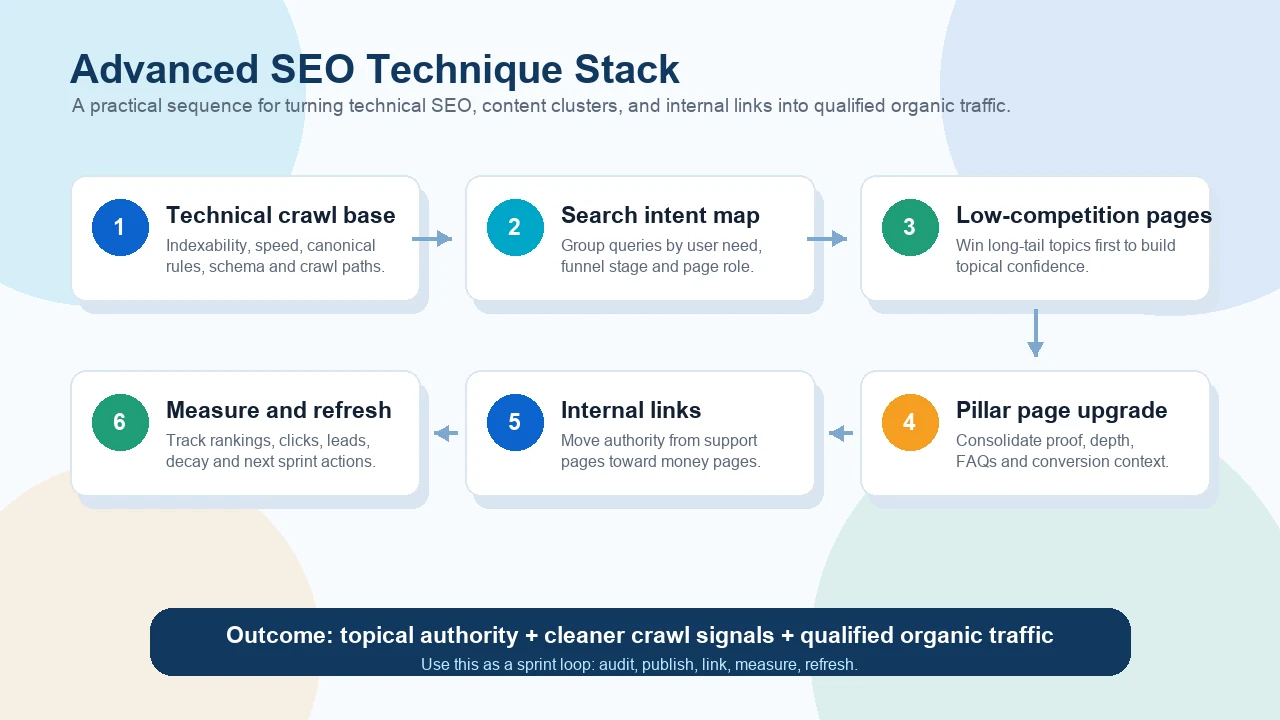
A strong SEO technique stack starts with a technical crawl. This does not mean exporting a long list of warnings and sending it to a developer without context. It means identifying the patterns that affect revenue pages, service pages, category pages, blog pages, and location pages. The practical questions are straightforward: which pages are indexable, which pages should be noindexed, which templates are slow, which canonical rules are inconsistent, which internal links are missing, and which pages are buried too deep?
For a service business, this may reveal that the homepage and service pages are fine, but the blog is poorly linked and articles are not supporting the main commercial pages. For an ecommerce site, it may reveal that category pages are diluted by faceted URLs, thin filters, and products that should not be in the sitemap. For a B2B company, it may reveal that thought leadership pages attract impressions but do not connect users toward the pages that explain the offer.
Before adding a reverse content cluster, run a crawl, inspect the rendered HTML, confirm mobile usability, test Core Web Vitals, and review index coverage. The cluster will work better if the site can already send clean signals. If you need a structured process for this part, the technical SEO audit page explains how SEOCastell turns crawl data into implementation priorities.
2. Map search intent instead of chasing isolated keywords
Keyword research is still useful, but the old habit of collecting search volumes and writing one article per keyword is too shallow. Search engines now evaluate meaning, usefulness, freshness, authority, and the relationship between pages. A query is not just a phrase. It represents a job the searcher is trying to complete. That job may be informational, comparative, local, transactional, diagnostic, or implementation-focused.
Search intent mapping turns keywords into page roles. A low-volume query such as "how to fix duplicate title tags on service pages" may be a support article. A commercial query such as "technical SEO audit agency" may need a service page. A comparison query such as "SEO audit vs content audit" may need a decision page. A local query may need proof, location relevance, reviews, and a strong contact path. When every query is mapped to the right role, the site stops producing content that competes with itself.
This is where reverse content clustering becomes useful. Instead of trying to rank a pillar page immediately for a competitive term, identify the narrower questions that the audience asks before they are ready to convert. These pages should be specific enough to win impressions, but relevant enough to support the larger topic. If the pillar page is about advanced SEO services, the support pages might cover crawl waste, content decay, internal link scoring, schema gaps, SEO dashboards, and long-tail topic selection.
The mistake to avoid is creating a cluster that only looks organized in a spreadsheet. A real cluster is visible in the website. It has clear navigation, contextual links, consistent language, related article blocks, breadcrumbs, and a reader journey that makes sense. The user should be able to move from a narrow problem to the larger solution without feeling pushed into a sales page too early.
3. Build from low-competition pages toward stronger pillar pages
The reverse cluster method is powerful because it respects how authority is earned. A new or underdeveloped site is unlikely to win immediately on broad competitive keywords. The smarter move is to find low-competition pages that match real intent and can be produced with unusual clarity. These pages may not have huge search volume individually, but together they create topical depth, internal link opportunities, and early data.
Start by identifying questions where competitors are weak. Look for results with thin content, outdated examples, poor formatting, missing images, no schema, vague answers, or no clear next step. These gaps are not always obvious in keyword tools. They appear when you read the search results as a user. Ask whether the page actually solves the problem, whether it includes proof, whether the advice is current, and whether it gives the next action.
Then build pages that are narrow enough to be useful. A weak article says "SEO tips for business". A stronger article says "how to use internal links to recover a decaying service page". The second page is easier to evaluate, easier to make helpful, and easier to connect to a service page or a broader pillar. When several of these pages begin to receive impressions, clicks, or links, you can use them to support the larger page.
The internal link pattern matters. The support page should link upward to the pillar page with descriptive anchor text. The pillar page should link back to the support page where it helps the reader go deeper. Related support pages should link to each other when the connection is natural. This creates a map of meaning, not a forced network of links. The anchor text should explain why the destination matters: "technical SEO audit process", "SEO content cluster strategy", or "Core Web Vitals fix framework" is more useful than "click here".
When a cluster is built this way, traffic does not stay trapped in the blog. It moves toward the pages that explain the offer. That is the difference between publishing and building an organic growth asset.
4. Upgrade the pillar page after the support layer starts working
A pillar page should not be a generic overview. It should become the strongest page on the topic for the audience you serve. Once support articles begin collecting impressions and engagement data, review the pillar page again. Does it answer the questions that searchers ask before they convert? Does it summarize the process clearly? Does it include proof, FAQs, schema, internal links, and a conversion path? Does it explain what makes your approach different?
This is where many teams underuse their own data. Search Console can show which support articles are earning impressions. Analytics can show which pages assist contact forms or product views. Sales conversations can reveal objections that the pillar page does not answer. A pillar upgrade should combine these signals into a stronger page, not simply add more words.
For example, if support pages show demand around content decay, crawl budget, internal linking, and Core Web Vitals, the pillar page can include modules for each topic. Each module can link to the relevant support article, explain the business impact, and guide users toward the next step. This makes the pillar page more complete without turning it into an unreadable encyclopedia.
For SEOCastell, a page about SEO services in India should not merely list services. It should connect technical auditing, content strategy, local visibility, ecommerce architecture, and reporting into one operating model. The blog supports that page by answering specific questions. The service page converts that understanding into a commercial conversation.
5. Use internal links as a distribution system, not decoration
Internal links are one of the most underrated advanced SEO techniques because they sit between content, architecture, and conversion. A link is not just a navigation element. It is a signal about relationship, priority, and user journey. When a site has strong pages but weak internal links, authority is scattered. When links are deliberate, the site becomes easier to interpret.
Start by defining the pages that should receive authority. These are usually service pages, category pages, product categories, key guides, comparison pages, or local landing pages. Then identify support pages that already receive impressions, backlinks, or engagement. These pages can pass relevance toward the priority pages through contextual links. The link should appear where the reader naturally needs the next resource.
A good internal link answers a question in the reader's head. If someone is reading about technical crawl problems, a link to a technical audit service is useful. If someone is reading about content clusters, a link to a B2B SEO content strategy guide is useful. If someone is reading about Core Web Vitals, a link to the Core Web Vitals framework helps them continue the journey. The link is not a trick; it is a service to the reader and a signal to search engines.
Review internal links every month. Add links from new articles to older priority pages. Add links from high-performing older articles to new pages that need support. Remove links that are irrelevant. Standardize anchor text where it helps, but avoid making every anchor identical. The goal is a natural network of useful recommendations.
6. Refresh old content before it becomes a ranking liability
Publishing new content is exciting. Refreshing old content is often more profitable. Many sites already have pages that earned impressions in the past but slowly lost visibility because the examples aged, competitors improved, screenshots became outdated, search intent changed, or the page stopped matching the current offer. These pages are not dead assets. They are candidates for recovery.
A content refresh should be more than changing the year in the title. Re-check the search results, update the structure, improve the answer, add missing sections, remove outdated claims, compress images, add schema, strengthen internal links, and improve the CTA. If the page targets an old keyword that no longer matches the business, consolidate it into a stronger page or redirect it where appropriate.
Content refreshes are especially useful inside a reverse cluster. Low-competition support pages may begin as small wins, but they should not remain static. As the cluster grows, each support page can be improved with links to new resources, better examples, and clearer next steps. The cluster becomes more valuable over time because every update strengthens the surrounding pages.

7. Measure the technique as a system, not as isolated rankings
Advanced SEO needs better measurement than "did the keyword move?" Rankings matter, but they are only one signal. A reverse cluster strategy should be measured by impressions, clicks, indexed pages, internal link coverage, assisted conversions, engagement, lead quality, and the movement of the pillar page over time. If support pages grow but the priority page never improves, the internal link and offer structure may be weak.
Create a simple scorecard. Track the support pages in each cluster, their target intent, publication date, last refresh date, internal links added, impressions, clicks, average position, conversion assists, and next action. Mark whether the page needs a technical fix, content expansion, link support, schema, image improvement, or consolidation. This turns SEO into a backlog, not a mystery.
Be patient but not passive. Some improvements can be verified immediately, such as indexability, broken links, image compression, and schema validity. Ranking changes require more time. Content clusters often need several crawl cycles before the relationship between pages is understood. The best teams review, adjust, and keep building instead of declaring success or failure too early.
Implementation checklist
Use this checklist to turn the technique into an execution plan:
- Run a technical crawl and fix indexation, canonical, sitemap, schema, and speed blockers.
- Group keywords by intent, page role, and business value.
- Find low-competition topics where the current search results are weak or outdated.
- Publish support pages that solve narrow problems better than existing results.
- Link each support page to the relevant pillar, service, category, or conversion page.
- Upgrade the pillar page using data from support-page performance and sales objections.
- Add contextual links between related articles where the next step is genuinely useful.
- Refresh old content before it decays, especially pages with declining impressions.
- Measure clusters by impressions, clicks, assisted conversions, and pillar-page movement.
- Repeat the sprint monthly: audit, publish, link, measure, refresh.
Final takeaways
The best SEO techniques are not shortcuts. They are repeatable habits that make the website clearer and more useful every month. Reverse content clustering is valuable because it gives teams a practical path into competitive topics: win the specific questions first, connect them through internal links, and use that momentum to strengthen the pages that matter commercially.
But the method only works when the basics are strong. The crawl base must be clean. Search intent must be mapped. Support pages must be genuinely useful. Pillar pages must be upgraded with proof and conversion context. Internal links must be deliberate. Results must be reviewed in clusters, not as scattered rankings. When those pieces work together, SEO becomes a compounding system rather than a calendar of isolated posts.
For teams that want to grow without creating a bloated archive, this is the useful discipline: publish fewer disconnected pages, build more connected assets, and make every new article improve the pages around it.